Abstract: Public examinations allocate scarce educational seats and public employment, so their integrity is central to social mobility, fairness and state legitimacy. This study builds an incident-level account of examination-integrity failures in India from 2015 to 2026, using a consolidated dataset of 118 documented incidents drawn from official notifications, court decisions, investigative releases and reporting. It measures documented failures—confirmed and alleged paper leaks, impersonation, digital compromise, OMR or result manipulation and organised cheating—not a legal census of proven offences. Descriptively, 93 incidents (78.8%) were labelled paper leaks, 75 (63.6%) ended in cancellation and 74 fell in 2021–2026; employment-linked examinations accounted for 96 (81.4%), extending the crisis into public recruitment. Contrasting the bounded breach recognised by the Supreme Court in NEET-UG 2024 with the nationwide re-examination of NEET-UG 2026 and reading the Ranchi JPSC/JSSC unrest as an accumulated trust deficit, a six-dimensional framework identifies economic, educational, psychological, social-equity, institutional-trust and governance costs, showing examination fraud to be a regressive shock. The paper proposes an Examination Integrity Index, chain-of-custody protocols, candidate protection, independent incident reporting and time-bound investigation and adjudication.
1. Introduction
Competitive examinations are among the most consequential administrative technologies of the modern Indian state. A single test can determine access to medical or engineering education, teaching posts and police, civil-service and other public jobs. Their legitimacy rests on a promise: every candidate faces the same paper, under comparable conditions, ranked by performance rather than money, influence, or manipulation. A breach reaches household finances, educational planning, labour-market entry, well-being and confidence in the institutions that certify merit.
India’s examination ecosystem is exceptionally large. National tests span thousands of centres and multiple jurisdictions, while state commissions and boards run high-volume recruitment examinations. Mass higher education, expanding coaching markets, persistent demand for secure public jobs and digital communication have raised both the value of credentials and the incentives for fraud. Beyond paper leaks, recent cases involve impersonation, hacking, remote-access tools, compromised OMR sheets, manipulated keys, collusive centres and interference in result processing.
The period 2015–2026 has seen repeated disruptions: examinations cancelled before being held or annulled after completion, forcing candidates to prepare again. The NEET-UG controversies are especially revealing. In 2024, the Supreme Court accepted a leak at Hazaribagh and Patna but found insufficient material for a system-wide breach warranting a national re-test. In 2026, the government referred allegations of unauthorised pre-examination circulation to the Central Bureau of Investigation (CBI) and the National Testing Agency (NTA) cancelled the 3 May examination and held a nationwide re-test on 21 June. The cost thus depends not only on the breach but on the speed and proportionality of the response.
The continuing mobilisation in Ranchi over alleged JPSC and JSSC irregularities adds another dimension: accumulated frustration with delays, recurring allegations, opacity and the vulnerability of candidates dependent on public recruitment. Because the case was still under investigation at the cut-off, the paper treats the allegations as unproven and reads the protests, arrests and inquiries as evidence of institutional strain.
This paper asks a broad question: what costs arise when the integrity of a high-stakes examination is compromised or credibly questioned? The answer is interdisciplinary. Economics identifies direct expenditure, opportunity cost and human-capital delay; education research, disrupted preparation and unequal access; psychology, the effects of uncertainty and stress; and sociology and public administration, distributive inequality, procedural justice, legitimacy and trust repair.
2. Conceptual Framework and Review of Literature
Human-capital theory treats education as an investment whose returns accrue through productivity and earnings (Becker, 1964). Competitive examinations mediate these returns by allocating access to education and employment, so a cancelled or delayed test interrupts investment, postpones work and reduces the present value of expected returns. Signalling theory adds that credentials inform employers (Spence, 1973); if the process seems compromised, the signal loses value, imposing costs even on honest candidates.
The literature on corruption in education places examination fraud within a broader institutional ecology. Hallak and Poisson (2007) show that corruption can affect admissions, assessment, certification, procurement and personnel, producing inefficient allocation, lower quality and lost confidence and the World Bank (2018) stresses that systems fail when inputs and institutions do not align around learning and accountability. Integrity is thus a governance outcome—secure processes, responsibility, reliable data and credible sanctions—not only day-of surveillance.
Procedural-justice scholarship is especially relevant: people accept institutional outcomes more readily when procedures are transparent, neutral and reviewable, even when adverse (Tyler, 2006). A high-stakes examination imposes an unusual procedural burden because candidates cannot observe the chain of custody—setting, printing, transport, storage, allocation, invigilation, scanning, evaluation and results. Trust is delegated, so a breach anywhere can contaminate perceptions of the whole system, especially when official communication seems delayed or contradictory.
High-stakes testing is also a psychosocial event. Research links test anxiety with lower performance (von der Embse et al., 2018), documents physiological stress that affects performance (Heissel et al., 2021) and connects academic stress with reduced well-being (Pascoe et al., 2020). Leaks add a second layer—uncertainty about cancellation, re-test dates, rank validity, counselling, or appointment. Because most Indian reports do not measure mental-health outcomes, the study treats psychological cost as an evidence-supported pathway, not a prevalence estimate.
The distributional consequences are likely unequal. Preparation involves fees, coaching, materials, digital access, travel, lodging and foregone earnings. The Comprehensive Modular Survey: Education, 2025 found coaching expenditure much higher in urban than rural areas and households the dominant source of educational financing (Ministry of Statistics and Programme Implementation [MoSPI], 2025). Candidates with savings, urban proximity and family support absorb a re-test more easily than those who borrowed or combined study with work, so a uniform remedy imposes unequal social costs.
Large-scale assessment is normally governed by standards of validity, reliability, fairness and protection of examinees (American Educational Research Association et al., 2014). Security cannot substitute for fairness: restrictive measures shift risk onto candidates, while opaque decisions intensify suspicion. A mature regime combines prevention, detection, transparent classification, proportional remedies and candidate protection. The High-Level Committee of Experts formed after 2024 recommended reforms in NTA governance, procedures, secure infrastructure and authentication (Ministry of Education, 2024).
Indian legal doctrine has repeatedly weighed protecting honest candidates against responding to a compromised process. In Tanvi Sarwal v. Central Board of Secondary Education (2015), the Supreme Court ordered a fresh AIPMT after finding the process vitiated. Later decisions ask whether tainted and untainted candidates can be segregated and whether cancellation is proportionate. In NEET-UG 2024, the Court declined a national re-test because the material showed no systemic breach and cancellation would seriously affect over two million candidates (Supreme Court of India, 2024)— linking legal proportionality to socio-economic cost.
The Public Examinations (Prevention of Unfair Means) Act, 2024 is the central legislative response, criminalising specified unfair means, organised examination crime and related institutional misconduct in notified examinations (Government of India, 2024). But criminalisation is only one layer: detection, procurement design, information security, coordination and timely remedies remain administrative and many state examinations fall under state frameworks, producing uneven implementation.
Available Indian datasets are valuable but heterogeneous. Newslaundry documented 89 suspected paper-leak cases over roughly a decade, 48 leading to re-tests (Newslaundry, 2024) and Parivartan’s compilation covers a broader fraud category and reports marked concentration after 2015 (Parivartan, 2026). Differences in definition, coverage and verification mean these counts are documented cases, not true prevalence.
3. Research Gap, Objectives and Analytical Propositions
The study responds to the absence of a unified incident-level account connecting examination fraud to socio-economic consequences. It does not claim complete national prevalence; its purpose is to organise available evidence, identify recurring cost pathways and establish a replicable framework for future official data collection.
3.1 Objectives
3.2 Research Questions
3.3 Analytical Propositions
4. Data and Methodology
The study uses a mixed-method, exploratory design: a quantitative incident-level descriptive analysis and a qualitative component of paired cases, documentary analysis and a six-dimensional assessment. Table 1 defines the unit of analysis—an examination-integrity incident, not an accused person, FIR, shift, or litigation. Multiple shifts in one controversy were coded as a single incident, while distinct examinations or annual cycles were coded separately.
The starting dataset was a working workbook of 116 incidents for 2015–2025, compiled from two consolidated public-interest sources and case-level reporting, with fields for year, examination, jurisdiction, authority, category, fraud type, evidence status, cancellation, re-test, candidate volume, investigation, outcome, source and confidence. Two 2026 cases—NEET-UG 2026 and the JPSC preliminary controversy—were added, giving 118 incidents (cut-off 5 August 2026).
Cases were included when a paper leak, organised cheating, impersonation, digital compromise, OMR or result manipulation, or comparable failure was reported by an official source, court record, credible investigative release, or established news organisation. Allegations under investigation were retained—their consequences are observable—and coded as alleged, investigated, disputed, or confirmed. Inclusion does not equate to guilt or judicial proof.
Table 2 sets out the four-tier source hierarchy: (1) court judgments, statutes and government or investigative-agency releases; (2) commission or agency websites and committee reports; (3) established news organisations; and (4) consolidated civil-society or investigative compilations. Confidence was coded High where cancellation, re-test, court recognition, or a chargesheet corroborated the case and Medium where a credible allegation remained unresolved.
The descriptive analysis reports counts and proportions by year, jurisdiction, sector, category and administrative outcome, with categories consolidated into employment-linked, education/admission and mixed/other. Candidate numbers are not unique persons—the field records registered, appeared, or affected candidates, the same person may sit several tests and most incidents lack a count—so the aggregate is a scale indicator, not a population estimate.
The qualitative analysis pairs NEET-UG 2024 and 2026: both are national medical entrance examinations at very large scale, but remedies differed—a limited re-test and no national cancellation in 2024, versus nationwide cancellation and re-examination in 2026. The comparison examines evidentiary thresholds, temporal response, candidate exposure and institutional learning. Selected state cases—REET, UPTET, BPSC, TSPSC, UKSSSC and JPSC/JSSC—identify recurring mechanisms.
The six-dimensional assessment uses a cost-pathway matrix: economic cost (out-of-pocket spending, foregone work, administrative expenditure, litigation, delayed earnings); educational cost (disrupted preparation, deferred admission or training); psychological cost (stress, uncertainty, loss of control); social-equity cost (unequal capacity to absorb repeated tests); institutional-trust cost (confidence in fairness and merit); and governance cost (investigation, security redesign, coordination, diverted attention).
No causal effect is estimated. The corpus is not a random sample and is vulnerable to media visibility, examination scale, state reporting and incomplete information, so inferential testing assuming a known sampling process would mislead. The paper uses transparent descriptive evidence and process tracing to identify patterns, mechanisms and policy implications, distinguishing what is counted, inferred and unknown.
Table 1: Operational Definitions
| Concept | Operational meaning in this study |
| Examination-integrity failure | A documented allegation or established instance of paper leakage, organised cheating, impersonation, digital compromise, OMR/result manipulation, answer facilitation, or comparable breach. |
| Documented incident | An examination-level event appearing in the compiled dataset; inclusion does not imply criminal conviction. |
| Cancellation | Official annulment of the examination or affected paper/shift, as coded in available sources. |
| Candidate-volume observation | Registered, appeared, or affected candidates where a source figure was available; not unique persons. |
| Socio-economic cost | Private or public losses across six dimensions, including non-monetary and distributional effects. |
| Confidence | High where corroborated by court/official action; Medium where credible allegation or investigation remained unresolved. |
4.1 Source and Validation Hierarchy
Table 2: Source Hierarchy Used for Case Validation
| Tier | Source type | Use |
| 1 | Court judgments, statutes, official notices, PIB/CBI releases | Primary basis for legal status, cancellation, re-test and official action |
| 2 | Commission websites and formal committee reports | Exam dates, candidate figures, rules and institutional recommendations |
| 3 | Established news organisations and wire services | Chronology, protests, arrests and case context |
| 4 | Investigative/civil-society compilations | Case discovery and broad trend triangulation; not treated as official census |
5. Empirical Profile of Examination-Integrity Failures, 2015–2026
The corpus contains 118 documented incidents between 2015 and 2026. Of these, 93 (78.8%) were labelled paper leaks; the rest combine impersonation, electronic cheating, hacking, OMR or result manipulation, mass cheating, or other procedural compromise. The leak label reflects prevalence and media visibility, not proof that leakage is the only or most important vulnerability.
Figure 1 and Table 3 show that incidents were unevenly distributed over time: 5 in 2015, 6 in 2016, 10 in 2017, 14 in 2018, 6 in 2019, 3 in 2020, 17 in 2021, 19 in 2022, 18 in 2023, 14 in 2024, 4 in 2025 and 2 current cases in 2026. The 2021–2026 period accounts for 74 incidents (62.7%), coinciding with a run of large recruitment and entrance controversies.
Figure 1: Documented examination-integrity incidents by year (2015-2026).

Note: Counts are from the analytical corpus and should not be interpreted as national incidence rates.
Figure 2 and Table 4 report the jurisdictional spread: the national level accounts for 24 incidents, followed by Rajasthan and Gujarat (10 each), Uttar Pradesh (9) and Uttarakhand (8). These are documented counts, not incidence rates—states run different examinations and stronger detection can make a jurisdiction look worse than one where failures stay hidden.
Figure 2. Leading jurisdictions and national-level examinations in the analytical corpus.

Note: National denotes centrally conducted or nationwide examinations.
Figure 3 and Table 5 show the sector split: employment-linked examinations account for 96 incidents (81.4%), against 22 education or admission incidents. Government recruitment is the largest category, followed by police, teacher, school-board, medical-entrance, teacher-eligibility, civil-service and health recruitment examinations. Integrity is thus a labour-market issue as much as an education one—for many aspirants a recruitment test is the gateway to stable income and mobility.
Figure 3. Broad sector distribution of documented incidents.
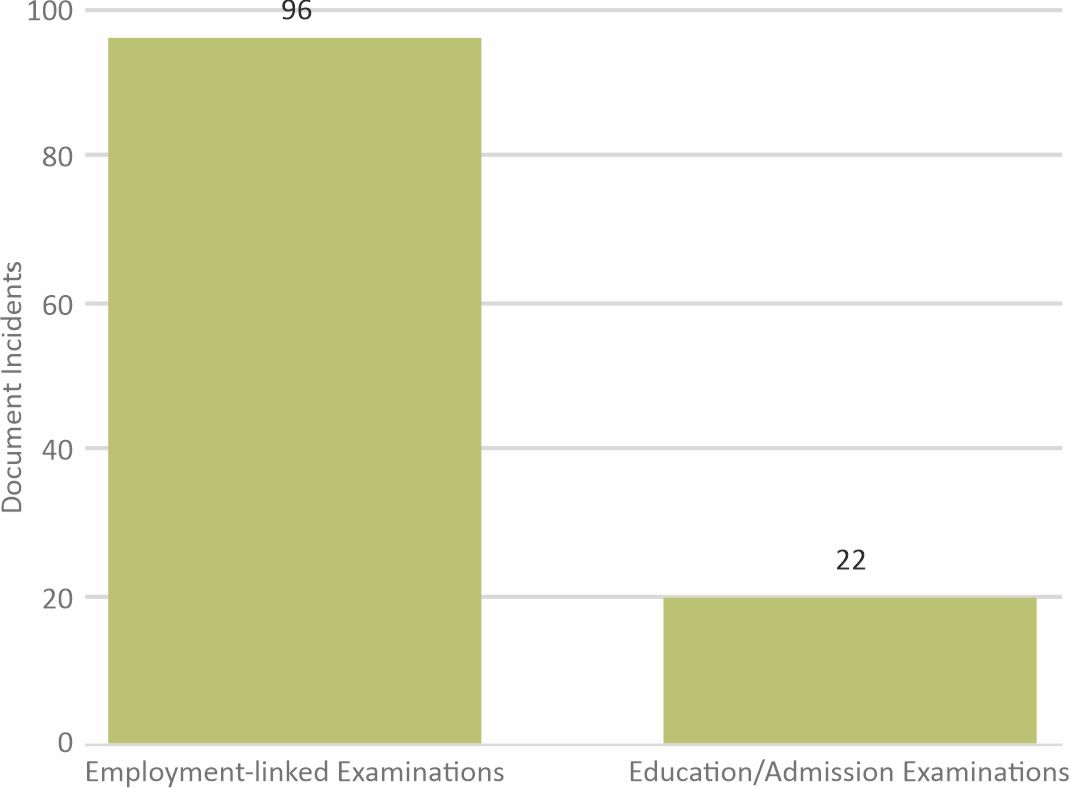
Note: Employment-linked includes recruitment, eligibility, civil-service, police and related examinations
Figure 4 shows substantial administrative disruption: 75 incidents (63.6%) were coded cancelled and 76 (64.4%) involved a replacement test held, limited to affected candidates, planned, or unresolved. Cancellation is visible but costly, shifting part of the burden to candidates. It appears more often in recruitment cases, where smaller units make re-testing more feasible than in a national examination of millions.
Candidate-volume figures exist for only 44 of 118 incidents, summing to roughly 47.6 million registrations, appearances, or affected-candidate entries—a conservative indicator of exposure, not a count of unique individuals, since most rows carry no figure. The recurring involvement of examinations with hundreds of thousands or millions of candidates explains why even a localised breach can trigger national concern.
The corpus also shows a shift in modes of compromise. Earlier cases centred on physical access, impersonation, or organised copying; recent ones include encrypted messaging, digital images, remote-access tools, server compromise, fabricated leak claims and insider collusion. A sealed packet no longer suffices if an insider can photograph content, centre systems are compromised, or fake documents spread fast enough to erode confidence before authentication.
Sensitivity checks reinforce caution: dropping the two ongoing 2026 cases does not alter the dominance of employment-linked examinations or the high cancellation share and restricting to High-confidence rows preserves the pattern. Breach frequency also differs from consequence: a small examination may fail severely with limited exposure, while a national test may face a bounded breach yet generate enormous uncertainty.
Figure 4. Administrative outcomes recorded in the dataset.
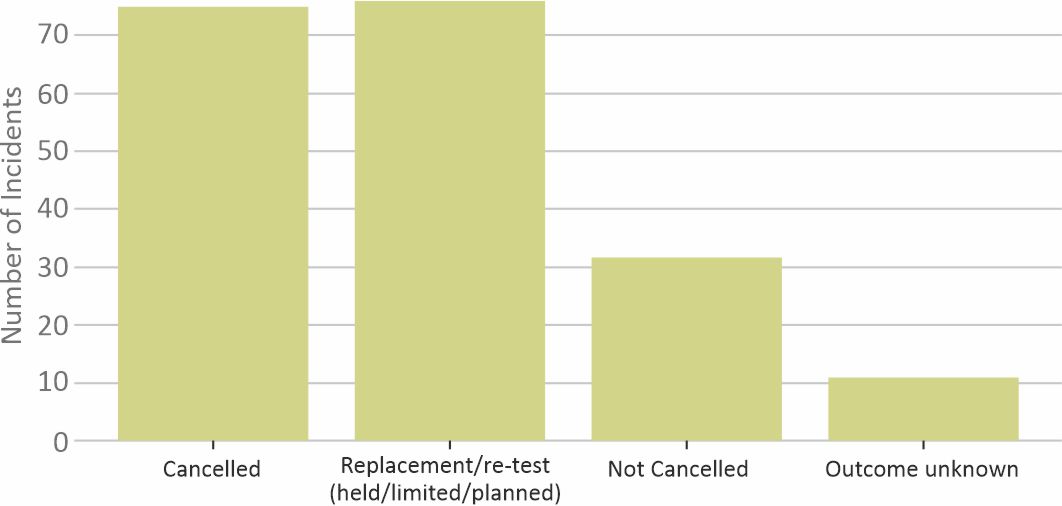
Note: Categories are not mutually exclusive: a cancelled examination may also have a replacement test.
Table 3: Incidence of Examination Integrity Failures
| Year | Incidents | Share (%) |
| 2015 | 5 | 4.2 |
| 2016 | 6 | 5.1 |
| 2017 | 10 | 8.5 |
| 2018 | 14 | 11.9 |
| 2019 | 6 | 5.1 |
| 2020 | 3 | 2.5 |
| 2021 | 17 | 14.4 |
| 2022 | 19 | 16.1 |
| 2023 | 18 | 15.3 |
| 2024 | 14 | 11.9 |
| 2025 | 4 | 3.4 |
| 2026 | 2 | 1.7 |
Table 4: Leading Jurisdictions/Levels
| Jurisdiction/level | Incidents | Share (%) |
| National | 24 | 20.3 |
| Rajasthan | 10 | 8.5 |
| Gujarat | 10 | 8.5 |
| Uttar Pradesh | 9 | 7.6 |
| Uttarakhand | 8 | 6.8 |
| Madhya Pradesh | 7 | 5.9 |
| Bihar | 7 | 5.9 |
| Telangana | 6 | 5.1 |
| Maharashtra | 5 | 4.2 |
| Karnataka | 5 | 4.2 |
| Haryana | 5 | 4.2 |
| Assam | 4 | 3.4 |
Table 5: Broad Sector and Cancellation Pattern
| Sector | Incidents | Share (%) | Cancelled | Cancellation rate (%) |
| Employment-linked examinations | 96 | 81.4 | 68 | 70.8 |
| Education/admission examinations | 22 | 18.6 | 7 | 31.8 |
6. Paired Case Study: NEET-UG 2024 and NEET-UG 2026
NEET-UG is an apt principal case: exceptional scale, intense competition, high household investment and centralised administration, allocating access to a high-return medical pathway—and thus both a human-capital gateway and a high-value target for fraud. The 2024 and 2026 episodes show how evidence, scale and institutional response shape consequences.
In NEET-UG 2024, about 2.4 million candidates registered and over 2.33 million appeared. The controversy had two strands: compensatory marks for 1,563 candidates for lost time and a paper leak connected to Hazaribagh and Patna. The first led to cancellation of those scorecards and an optional re-test for the 1,563; the second prompted police and CBI investigation, litigation, publication of centre-wise results and judicial scrutiny.
The Supreme Court’s judgment of 23 July 2024 is central. The Court accepted the Hazaribagh–Patna leak but found no material showing a systemic breach affecting the examination nationally. It declined a fresh examination because the threshold for system-wide cancellation was unmet and a re-test would seriously affect more than two million students—illustrating proportionality: a remedy must protect fairness without imposing unnecessary costs on untainted candidates (Supreme Court of India, 2024).
The 2024 case nonetheless imposed significant costs: candidates faced uncertainty over ranks and counselling and whether the examination would survive review and NTA and the government had to disclose data, run a limited re-test, contest litigation and redesign security. The CBI filed multiple charge sheets and a High-Level Committee of Experts reviewed NTA structure, processes, data security and centre operations.
NEET-UG 2026 produced a different response. NTA reported about 22.79 lakh registrations and extensive pre-examination security. After the 3 May examination, the Ministry of Education referred allegations of unauthorised circulation to the CBI, which registered a case under the Bharatiya Nyaya Sanhita, the Prevention of Corruption Act and the Public Examinations Act, 2024. Official releases reported arrests—including a person with allegedly authorised access—and said disclosed questions matched the paper; the process remained ongoing, so culpability must be determined through due process.
NTA cancelled the 3 May examination and held a nationwide re-examination on 21 June 2026. This protected the principle that all candidates be assessed on an uncompromised paper, but created a second preparation cycle and delayed the calendar, forcing candidates to revisit logistics and sustain study intensity. NTA also processed refunds and deployed enhanced biometric, centre and communication measures.
Table 6 sets the two cases side by side, revealing three lessons. First, the cost of uncertainty can rival the remedy: in 2024 candidates waited through prolonged litigation, while in 2026 nationwide cancellation created certainty at the price of repetition. Second, the remedy depends on whether affected candidates can be segregated—bounded in 2024, treated as uncontainable in 2026. Third, stronger legislation and security improve detection but cannot eliminate insider risk or the reputational effect of fast-circulating digital claims.
A purely monetary estimate would be incomplete. Fees and travel can be counted, but anxiety, deferred counselling, lost preparation and weakened confidence are harder to price and the same event has uneven effects—a second journey may bind a low-income rural candidate, while an urban candidate bears extra coaching fees and delayed transition. Because candidates experience the interval between allegation and remedy as an option-value problem, authorities should publish a decision calendar and update candidates at fixed intervals.
Table 6: NEET-UG 2024 and 2026: Comparative Institutional Response
| Dimension | NEET-UG 2024 | NEET-UG 2026 |
| Scale | 2.406 registered; 2.333 appeared (In million) | About 2.279 registered; 1.999 appeared (In million) |
| Integrity finding/status | Leak at Hazaribagh and Patna acknowledged by Supreme Court; no evidence of system-wide breach sufficient for national re-test | CBI FIR on alleged unauthorised pre-exam circulation; official releases reported arrests and matching questions; investigation ongoing |
| Immediate remedy | Limited re-test for 1,563 grace-mark candidates; national examination upheld | 3 May examination cancelled; nationwide re-examination on 21 June 2026 |
| Decision institution | Supreme Court after extensive litigation, with NTA/government measures | NTA/government administrative decision alongside CBI investigation |
| Primary candidate cost | Prolonged uncertainty about validity, rank, counselling and litigation outcome | Repeat preparation and travel, rescheduled calendar, delayed results/counselling |
| Policy significance | High-Level Committee and reforms to NTA governance/security | Test of the 2024 Act, enhanced security and candidate communication measures |
7. Comparative Recruitment Cases and the Ranchi Trust Deficit
Table 7 lists selected state recruitment cases, which differ from national admissions tests. UPTET 2021 was cancelled on examination day after a confirmed leak; REET 2021 led to cancellation and re-testing; BPSC’s 67th preliminary (2022) was cancelled after a leak and re-conducted; the TSPSC 2022–2023 cluster saw multiple cancelled tests; and UKSSSC/UKPSC cases produced repeated cancellations across graduate, forest, police, patwari and engineering recruitment. A leak migrates across examinations when the vendor, insider network, or security culture is not corrected.
The JPSC/JSSC mobilisation in Ranchi illustrates cumulative rather than event-specific grievance. The 2026 JPSC preliminary reportedly drew over 36,000 candidates, with 2,204 qualified. After viral material and allegations of irregularities, the Jharkhand CID registered a case and made arrests; aspirants began a sustained protest and sought cancellation and a CBI inquiry. By 4 August, reports placed arrests at 14, with investigation and decision pending at the cut-off. When candidates believe a commission has not explained discrepancies quickly and independently, protest becomes a means of demanding transparency and the social cost grows to include policing, litigation risk and distrust of genuine explanations.
Across the cases, three vulnerabilities recur: trusted-insider access, outsourced operational chains and delayed communication. The first calls for role-based access, segregation of duties and conflict-of-interest safeguards; the second for procurement standards, cross-state vendor blacklisting and subcontractor liability; the third for pre-agreed communication of what is known, what evidence is preserved and when the next decision falls. Silence or denial before facts are established deepens the eventual trust loss.
Table 7: Selected Comparative Cases
| Case | Integrity issue | Administrative consequence | Socio-economic relevance |
| UPTET 2021 | Confirmed paper leak | Cancelled and re-tested | Large teacher-eligibility cohort; repeated travel and preparation |
| REET 2021 | Paper leak | Affected level cancelled/re-held; investigation | Teacher recruitment, household coaching cost, institutional scrutiny |
| BPSC 67th Prelims 2022 | Paper leak | Cancelled and re-conducted | Civil-service delay and prolonged aspirant uncertainty |
| TSPSC cluster 2022–2023 | Compromise of confidential material | Multiple examinations cancelled | Systemic rather than one-exam vulnerability |
| UKSSSC/UKPSC 2021–2023 | Repeated recruitment leaks | Multiple cancellations and arrests | Cumulative trust loss and recruitment backlog |
| JPSC/JSSC 2026 | Alleged leak/process irregularities; investigation ongoing | CID probe, arrests, sustained Ranchi protests; final outcome pending | Illustrates cumulative grievance, protest cost, and demand for independent inquiry |
8. Six-Dimensional Socio-Economic Impact Assessment
Figure 5 maps the six dimensions, analytically distinct but mutually reinforcing. A cancelled examination produces financial loss; strain intensifies stress; unequal capacity to absorb a re-test widens inequity; perceived inequity erodes trust; low trust fuels litigation and protest; and these raise governance costs. The framework treats an integrity failure as a cascading institutional shock, not a single error.
Figure 5. Six-dimensional socio-economic cost framework.

Note:The framework identifies impact pathways; it does not assign causal effect sizes.
8.1 Economic costs
Direct private costs include fees, coaching, materials, digital subscriptions, transport, lodging, food and documentation; on cancellation some recur while others become sunk. MoSPI’s 2025 education survey shows coaching to be a meaningful household expense, higher in urban but substantial in rural areas. Because households finance most educational spending, a re-test acts like an unplanned household levy.
Opportunity cost is larger but less visible. Candidates may take leave, cut paid work, postpone other examinations, or stay out of employment while preparing; a delayed recruitment cycle defers wages and can lower lifetime earnings and seniority. Authorities bear printing, secure transport, centre hire, personnel, policing, biometrics, refunds, investigation, litigation and re-testing costs—resources diverted from other priorities.
8.2 Educational costs
Admission and recruitment examinations structure learning calendars. A leak can invalidate months of preparation, force repeated revision and delay counselling, college entry, training, or appointment. In medical admissions it disturbs seat allocation; in school-board cases it interferes with transition to higher education; in recruitment it leaves vacancies unfilled, with downstream effects on service delivery.
8.3 Psychological costs
High-stakes examinations already produce anxiety; integrity failures add uncertainty and perceived injustice. Candidates may not know whether to keep preparing, whether results will stand, or whether counselling and appointments will slip—a loss of control that sharpens when official messages shift mid-investigation. Test-anxiety and academic-stress research supports effects on sleep, concentration, performance and well-being, though this dataset cannot estimate prevalence.
8.4 Social-equity costs
The capacity to absorb disruption is uneven. Candidates near centres reappear at lower cost than those from remote districts; affluent families finance extra coaching and lodging while poorer candidates borrow, lose wages, or abandon an attempt; women may face mobility and safety constraints; and candidates with disabilities need renewed accessibility. Language, digital access and legal literacy further shape who can contest an irregularity.
8.5 Institutional-trust costs
Examinations are trust-intensive: most candidates cannot observe the security chain and must rely on the authority’s competence and neutrality. Repeated failures create a Bayesian effect, each allegation read through the memory of earlier ones, so even a fabricated claim can trigger panic when credibility reserves are thin. Transparent disclosure and independent verification can, conversely, contain the damage.
8.6 Governance and policy costs
Integrity failures consume administrative bandwidth: senior officials, courts, police, cyber units and agencies must respond; calendars are redrawn; procurement is reviewed; and legislatures face pressure to act. The Public Examinations Act, 2024 strengthens deterrence, but its effect depends on implementation, state coordination, forensic capacity and evidence protection.
8.7 Interaction and cumulative burden
Table 8 arranges the six dimensions, which should not be summed mechanically because they interact. A candidate who loses wages for a re-test may also face greater stress, cut further coaching and trust the next result less; a delayed appointment can extend household dependency and reshape debt or migration decisions; and low trust raises litigation, protest and governance cost. Because the data record incidents, not individual histories, future surveys should capture disrupted examinations, cumulative delay, extra borrowing and exit from preparation.
Table 8: Six-Dimensional Impact Matrix
| Dimension | Candidate/household effects | Institutional/public effects | Illustrative indicators |
| Economic | Fees, travel, coaching, lodging, foregone wages, delayed earnings | Re-test, security, refunds, investigation, litigation | Per-candidate repeat cost; public re-test cost; delay days |
| Educational | Lost preparation, disrupted calendar, deferred admission/training | Academic-calendar and vacancy disruption | Days of delay; counselling/appointment postponement |
| Psychological | Anxiety, uncertainty, burnout, loss of control | Helpline and communication burden | Validated stress survey; uncertainty duration |
| Social equity | Unequal ability to finance repeat attempt or access remedies | Risk of exclusion and regressive impact | Rural/urban, income, gender, disability differentials |
| Institutional trust | Reduced acceptance of results and merit claims | Litigation, protest, reputational damage | Trust survey; grievance rate; litigation volume |
| Governance | Dependence on investigation and judicial relief | Administrative diversion, reform and enforcement cost | Response time; audit findings; closure time |
9. Proposed Examination Integrity Index (EII)
Counting scandals is a poor measure of institutional quality, since better detection raises observed incidents. Figure 6 outlines a proposed Examination Integrity Index and Table 9 lists its illustrative dimensions—a 0–100 readiness and response score for an authority or examination, built on six weighted dimensions. It is not calculated here, as comparable audit data are not public; it is offered as a testable policy instrument requiring independent assessors, pilot scoring and validation against outcomes such as detected breaches, response times and recurrence.
Figure 6. Proposed Examination Integrity Index architecture.
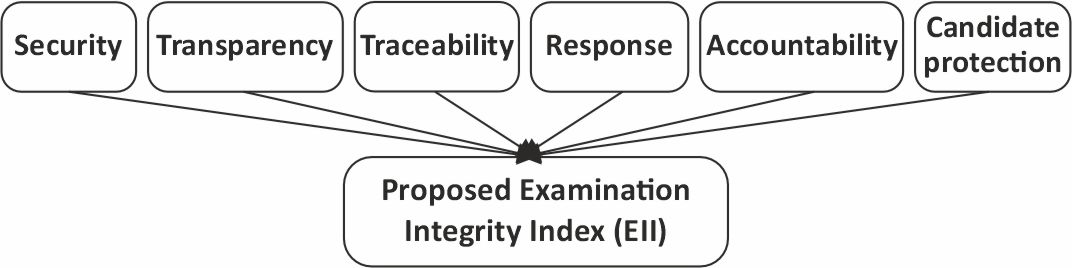
Note: Dimensions require validation, standardised audit evidence and transparent scoring rules.
Table 9: Illustrative Examination Integrity Index Dimensions
| Dimension | Illustrative weight | Core evidence |
| Pre-examination security | 20 | Access control, paper-setting separation, printing/logistics audit, insider-risk controls |
| Centre and identity assurance | 15 | Centre accreditation, biometrics, accessibility, invigilator vetting |
| Digital traceability and analytics | 15 | Immutable logs, anomaly detection, cyber audit, evidence retention |
| Transparency and communication | 15 | Incident protocol, disclosure timetable, grievance information |
| Response and candidate protection | 20 | Decision speed, remedy proportionality, refunds, age/attempt safeguards |
| Accountability and learning | 15 | Independent review, vendor sanctions, prosecution status, lessons-learned report |
A valid index would require independent assessors, documentary evidence, pilot scoring across national and state bodies, inter-rater reliability testing and public methodology and must not become a checklist rewarding paperwork. Outcome indicators—detected breaches, response times, recurrence—should be read alongside process scores: an authority that detects and reports an attempted breach may be more mature than one reporting none for want of surveillance.
10. Discussion
The profile supports three interpretations. First, integrity failure is a systemic governance risk, not isolated cheating: the same vulnerabilities recur—insider access, outsourced operations, weak traceability, fragmented responsibility, delayed communication—and their concentration in employment-linked examinations ties the problem to youth labour markets and the scarcity of secure public jobs.
Second, cancellation is both remedy and harm: necessary for comparability, yet costly to candidates who did nothing wrong, so segregating tainted candidates is also a socio-economic question. The 2024 and 2026 NEET cases show two defensible but costly paths—preserve the examination when a breach is bounded, or re-test the whole cohort when it is not—each needing explicit candidate-protection and cost-mitigation rules.
Third, public trust behaves like an institutional asset, built by reliable conduct and depleted by failure, denial, opacity, or inconsistency. Security reforms lower breach probability, but trust needs communicative and procedural competence: a secure re-test may still feel unfair if centres are inaccessible, information is fragmented, or the authority never explains why the remedy is proportionate.
Finally, the corpus reveals a data deficit: India has no unified public register recording the examination, candidates, breach, time of detection, remedy, public cost, investigation status and outcome. This weakens institutional learning; an official register would enable recurrence analysis, vendor-risk monitoring and evidence-based evaluation of the 2024 Act.
It also contributes to procedural-justice analysis: acceptance depends not only on the result but on whether the authority explains its evidence, treats similar candidates consistently and offers a real route to review. Proportionality is thus an empirical governance practice, not only a doctrine—a poorly communicated remedy may fail to restore legitimacy, while a transparent one with visible candidate protection reduces the social afterlife of a breach.
11. Policy Recommendations
The policy response to examination integrity failures must combine deterrence with prevention, transparent decision-making, institutional accountability and meaningful protection for candidates. Criminal penalties are necessary, but they cannot by themselves secure complex examination systems or restore public confidence after a breach. The following recommendations are therefore organised around the full examination life cycle—from paper setting and vendor selection to incident management, remedial action and post-incident review—and are intended for central agencies, state commissions, recruitment boards and other authorities responsible for high-stakes public examinations.
11.1 Establish a National Examination Integrity Registry.
The Union Government should establish a National Examination Integrity Registry with interoperable participation by state governments, public service commissions, recruitment boards, universities and national testing agencies. Every credible or formally notified integrity incident should receive a unique identification number and be classified according to the type of failure, examination category, number of candidates exposed, geographical spread, remedial action, investigating agency and final status. The registry should distinguish allegations, confirmed breaches, administrative irregularities and adjudicated offences so that unverified claims are not presented as established facts. A standardised registry would enable trend analysis, reveal repeat vulnerabilities, reduce fragmented reporting and provide policymakers with a reliable basis for evaluating whether preventive reforms are actually reducing risk.
11.2 Adopt an end-to-end chain-of-custody architecture.
Every high-stakes examination should operate under a documented, auditable and technology-supported chain of custody from question-paper preparation to result publication. Access to sensitive material should be strictly role-based, with segregation of duties so that no single employee, vendor or centre official can control multiple critical stages. Immutable audit logs, encrypted transfers, geo-tagged handovers, tamper-evident packaging, dual authentication and independent reconciliation should be mandatory wherever appropriate. The system should record who accessed, printed, transported, stored, opened or modified examination material and at what time. Such traceability would not eliminate insider risk, but it would make unauthorised access more difficult, improve early detection and preserve evidence for swift investigation and accountability.
11.3 Create a national vendor and personnel risk-management system.
Examination authorities should maintain a common risk-management system covering printing presses, technology vendors, logistics providers, examination centres, invigilators and key personnel. Verified security violations, contractual defaults, debarments, criminal proceedings and adverse audit findings should be recorded and, subject to due process, made visible to other authorised agencies across jurisdictions. Vendors should not be able to re-enter the examination ecosystem through a new subsidiary, subcontractor or state-level contract after serious misconduct elsewhere. At the same time, the system must protect against arbitrary blacklisting by specifying notice, hearing, appeal and review procedures. A coordinated risk register would reduce repeated engagement of compromised entities and would make institutional memory portable across agencies and states.
11.4 Mandate independent pre- and post-examination security audits.
Independent security audits should be compulsory for high-volume and high-stakes examinations, with the scope extending beyond routine compliance certification. Pre-examination audits should test insider threats, cyber security, question-paper generation, printing controls, logistics, centre accreditation, biometric systems, surveillance, contingency planning and the readiness of complaint channels. Post-examination audits should reconcile access logs, packet movement, attendance records, digital events, CCTV availability, abnormal score patterns and deviations from prescribed procedures. Auditors should report directly to an empowered oversight body rather than to the operational unit being assessed. Findings should be graded by severity, accompanied by time-bound corrective action and followed by verification, ensuring that audit becomes a preventive governance instrument rather than a procedural formality.
11.5 Define and publish graded remedy thresholds.
Examination authorities should adopt transparent, pre-declared criteria for deciding whether an integrity failure requires centre-level correction, a shift-specific re-test, score adjustment, localised re-examination or cancellation of the entire examination. The decision framework should consider the credibility of the evidence, geographical and candidate spread, whether affected candidates can be reliably separated, whether the compromised advantage can be neutralised, the probability of wider contamination and the social cost of each remedy. Reasons for the chosen response should be published without disclosing information that could prejudice investigation or future examination security. A graded framework would reduce ad hoc decision-making, improve consistency across incidents and help candidates understand why similarly serious cases may legitimately require different remedies.
11.6 Introduce a legally enforceable Candidate Protection Charter.
A Candidate Protection Charter should set out the minimum rights and relief available when an examination is cancelled, postponed or materially disrupted because of official or vendor failure. The charter should provide automatic refund or adjustment of examination fees, assistance with re-allotted centres, accessible arrangements for candidates with disabilities, reasonable protection regarding age limits and number of attempts and time-bound decisions on revised schedules and results. Where negligence is formally established, authorities should also consider compensation for demonstrable travel, accommodation or related losses, particularly for economically vulnerable candidates. The charter should create a simple claims process and an independent appeal mechanism so that candidate welfare is treated as a core component of examination governance rather than a discretionary administrative concession.
11.7 Require post-incident socio-economic cost statements.
After every major examination failure, the responsible authority should publish a post-incident cost statement that records the direct and indirect consequences of the disruption. At a minimum, it should disclose public expenditure on cancellation, investigation, litigation, fresh printing, centre mobilisation, security and re-examination, along with candidate reimbursements and delays to admission or recruitment calendars. Where precise household costs cannot be measured, the authority should provide a transparent estimate based on candidate numbers, travel patterns and the duration of delay. Making these costs visible would improve public accountability, allow comparison across agencies and create stronger institutional incentives to invest in prevention. It would also shift policy discussion from counting arrests to understanding the full social burden of examination failure.
11.8 Establish a 24-hour evidence-preservation protocol.
All examination bodies should implement a mandatory evidence-preservation protocol that becomes operational immediately after a credible alert. Within the first 24 hours, relevant digital logs, server images, CCTV footage, biometric records, printer activity, access-control data, communications, transport records, packet seals and centre documentation should be secured under a recorded chain of custody. The protocol should identify authorised officers, escalation levels, forensic procedures and circumstances requiring police or specialised cyber-agency involvement. Automatic retention periods should be long enough to prevent routine deletion before an irregularity is detected. Rapid preservation is essential because many integrity cases fail not from absence of suspicion but from loss, alteration or fragmentation of evidence during the period between the examination and the formal investigation.
11.9 Separate criminal investigation, technical validity assessment and public communication.
Incident management should distinguish three functions that are often confused: criminal investigation, technical assessment of examination validity and communication with candidates. Police or specialised agencies should investigate offences; an independent technical panel should assess whether the examination outcome remains statistically and procedurally defensible; and a designated spokesperson should issue verified, scheduled updates. Separating these responsibilities would prevent premature public claims from compromising investigation and would ensure that criminal arrests are not treated as a substitute for determining whether scores remain valid. Regular communication should explain what is known, what remains under examination, the expected decision process and the candidate-relief measures being activated. Clear institutional roles can reduce misinformation, uncertainty and avoidable escalation of student unrest.
11.10 Use privacy-preserving analytics for early detection.
Examination agencies should use auditable, privacy-preserving analytical tools to identify unusual centre-level performance, improbable response similarity, abnormal score clustering, irregular timing and other patterns that may signal organised malpractice. Analytics should function as an early-warning and investigative-support mechanism rather than as an automated system for declaring candidates guilty. Any model used should be tested for false positives, bias and explainability and its outputs should be reviewed alongside documentary, forensic and field evidence. Candidate data should be minimised, securely stored and accessed only for defined purposes. Properly governed analytics can help authorities identify localised breaches quickly and avoid unnecessary nationwide disruption, while due-process safeguards can prevent innocent candidates from being penalised solely because they belong to an anomalous statistical group.
11.11 Reduce excessive outsourcing and fix accountability across subcontracting chains.
Examination authorities should retain strategic control over question-paper security, access permissions, incident response and audit, even when operational functions are outsourced. Contracts should clearly specify security standards, permissible subcontracting, personnel vetting, data ownership, audit access, breach-reporting duties, evidence-preservation obligations and financial liability for verified failures. Prime contractors should remain accountable for the conduct of subcontractors and should disclose the complete service-delivery chain before appointment. Sensitive functions should not be fragmented among multiple unmonitored vendors merely to reduce cost. Liquidated damages, performance guarantees, debarment and criminal referral should be available where appropriate, but contractual sanctions should be accompanied by continuous oversight so that accountability is preventive and not activated only after a scandal.
11.12 Develop common minimum standards for state examination bodies.
The Union and state governments should jointly develop common minimum standards for public service commissions, recruitment boards and other state examination agencies while preserving their constitutional and administrative autonomy. The standards should cover institutional governance, procurement, cyber security, question-paper handling, vendor due diligence, centre accreditation, grievance redress, conflict-of-interest disclosure, incident classification, public reporting and candidate protection. Smaller commissions should receive technical and financial assistance to meet these requirements rather than being subjected to unfunded mandates. Periodic peer review among examination bodies could help disseminate good practices and identify recurring weaknesses. Common standards would reduce uneven security capacity across states and create a baseline of fairness for candidates competing for public opportunities under different administrative systems.
11.13 Establish fast-track but procedurally fair adjudication.
Serious examination offences should be investigated and tried through specialised, time-bound mechanisms capable of handling digital evidence, organised networks and cross-state activity. Fast-track processes, however, must not dilute due process or allow arrest figures to be presented as proof of final accountability. Investigating agencies should publish periodic status summaries, courts should prioritise evidence-sensitive cases and disciplinary proceedings against public officials should move independently where service rules permit. Mechanisms should also exist to clear wrongly accused candidates and restore their eligibility without prolonged uncertainty. Speed and fairness are complementary: delayed prosecution weakens deterrence and public confidence, while procedurally weak prosecution risks acquittal, wrongful stigma and further erosion of trust in the examination system.
11.14 Integrate psychological support into incident-response plans.
Major examination disruptions should trigger a structured psychological-support response, particularly when millions of candidates face uncertainty over re-testing, admission or employment. Authorities should provide verified timelines, multilingual helplines, frequently updated information, counselling referrals and guidance for parents and institutions. Communications should avoid sensational language and repeated speculative deadlines, both of which can intensify anxiety. Universities, coaching institutions and district administrations may be enlisted to disseminate reliable information and identify candidates requiring support. Psychological assistance should not be treated as a substitute for swift administrative decisions; rather, it should accompany transparent action. Reducing uncertainty is itself a form of candidate protection and can mitigate panic, burnout, loss of concentration and prolonged disengagement from education or employment preparation.
11.15 Commission independent annual evaluations of the Public Examinations Act, 2024.
The implementation of the Public Examinations (Prevention of Unfair Means) Act, 2024 should be reviewed annually by an independent body with access to investigation, prosecution and administrative data. Evaluation should examine the number and type of cases registered, prosecution and conviction outcomes, time taken for disposal, state-level adoption or complementary legislation, the role of organised networks and any displacement towards new fraud methods. It should also assess whether enforcement has improved prevention and candidate confidence or has primarily increased punitive activity after incidents occur. The evaluation report should be placed in the public domain and should recommend amendments, capacity-building and inter-agency coordination. Evidence-based review would prevent the law from being judged solely by penalties on paper or isolated high-profile arrests.
11.16 Institutionalise candidate representation in examination governance.
Examination bodies should create permanent advisory mechanisms through which candidates can contribute to operational reform and incident-response planning. Panels should include current and former aspirants, rural candidates, women, persons with disabilities, representatives of economically weaker groups, subject experts and professionals familiar with large-scale testing. Their role should include reviewing application processes, centre allocation, communication protocols, grievance systems, re-examination arrangements and accessibility. Candidate representatives should not have access to confidential examination content, but they can identify practical burdens that administrators may overlook, such as unaffordable travel, inaccessible centres or unrealistic rescheduling. Institutionalised participation would improve policy design, increase procedural legitimacy and demonstrate that candidates are stakeholders in the examination system rather than merely recipients of administrative decisions.
11.17 Publish a lessons-learned report after closure of every major case.
Within six months of the administrative or judicial closure of a major integrity incident, the responsible authority should publish a structured lessons-learned report. The report should identify the root cause, stage of failure, control weaknesses, role of insiders or vendors, evidence-preservation performance, candidate impact, remedy chosen, corrective measures and deadlines for implementation. Sensitive operational details that could facilitate future malpractice or prejudice prosecution may be withheld, but the reasons for redaction should be stated. Corrective actions should be assigned to named institutional units and followed through in subsequent audit reports. A formal learning process would help examination systems retain institutional memory, prevent recurrence and demonstrate to candidates that inquiries lead to concrete reform rather than disappearing once public attention declines.
12. Limitations and Future Research
The study has important limitations. The dataset is a working compilation, not an official census and media-rich, high-volume, politically salient examinations are likelier to be documented. Definitions vary across sources, some incidents combine mechanisms and allegations under investigation are included but labelled. Candidate counts are incomplete and non-unique and household spending unobserved, so the analysis cannot estimate national prevalence, causal effects, or a precise aggregate cost.
The proposed Index is a policy framework, not a validated psychometric instrument; its weights are illustrative and require expert consultation, pilot testing, inter-rater reliability assessment and validation against independent outcomes. The 2026 cases were ongoing at the cut-off and later findings may alter their classification.
Future research should field a candidate-level survey after a major cancellation, linking household spending, distance, employment, income, gender, disability, stress and trust and use administrative data to estimate appointment delays and public re-test costs. A validated EII could then be tested against recurrence, response time, grievances and legal outcomes.
13. Conclusion
Examination integrity is socio-economic infrastructure: it determines whether educational and employment opportunities are allocated through credible, merit-based procedures. The corpus shows failures that are recurrent, concentrated in employment-linked examinations and often followed by cancellation or re-testing. The visible event is a leak or manipulation; the wider consequence is a chain of household, educational, psychological, distributive, institutional and governance costs.
A durable response must move beyond harsher punishment: India needs auditable examination architecture, transparent remedy thresholds, candidate protection, vendor accountability, rapid evidence preservation and a public integrity registry. The proposed Index measures institutional readiness rather than merely counting scandals; the aim is to build systems in which a breach is difficult, detectable, containable and followed by a fair remedy.
The fundamental promise of a public examination is equality before the question paper. Protecting that promise is essential to educational justice, labour-market legitimacy and public trust in the state.
REFERENCES
American Educational Research Association, American Psychological Association, & National Council on Measurement in Education. (2014). Standards for educational and psychological testing. American Educational Research Association.
Becker, G. S. (1964). Human capital: A theoretical and empirical analysis, with special reference to education. University of Chicago Press.
Bordoloi, M., & Kapoor, V. (2018). India: Using open school data to improve transparency and accountability. UNESCO International Institute for Educational Planning. https://www.iiep.unesco.org/en/publication/india-using-open-school-data-improve-transparency-and-accountability
Central Bureau of Investigation. (2024, November 22). CBI files fifth chargesheet in NEET-UG 2024 paper leak case. https://cbi.gov.in/ press-detail/NjY1Mg%3D%3D
Central Bureau of Investigation. (2026, May 12). CBI registers case in alleged paper leak in NEET-UG 2026 [Press release reproduced by Press Information Bureau]. https://www.pib.gov.in/ PressReleasePage.aspx?PRID=2260410&lang=2®=48
Central Bureau of Investigation. (2026, May 15). CBI arrests a kingpin in NEET-UG 2026 paper leak case [Press release reproduced by Press Information Bureau]. https://www.pib.gov.in/ PressReleasePage.aspx?PRID=2261634&lang=2®=48
Government of India. (2024). The Public Examinations (Prevention of Unfair Means) Act, 2024 (Act No. 1 of 2024). India Code. https://www.indiacode.nic.in/handle/123456789/20100?locale=en
Hallak, J., & Poisson, M. (2007). Corrupt schools, corrupt universities: What can be done? UNESCO International Institute for Educational Planning. https://www.iiep.unesco.org/en/ publication/corrupt-schools-corrupt-universities-what-can-be-done
Heissel, J. A., Adam, E. K., Doleac, J. L., Figlio, D. N., & Meer, J. (2021). Testing, stress and performance: How students respond physiologically to high-stakes testing. Education Finance and Policy, 16(2), 183–208. https://doi.org/10.1162/edfp_a_00306
Ministry of Education. (2024). Reformation of national common entrance testing in India: Recommendations of the High-Level Committee of Experts. Government of India. https://www.education.gov.in/sites/upload_files/mhrd/files/HLCE_Report.pdf
Ministry of Education. (2024, June 22). Ministry of Education entrusts the matter of alleged irregularities in NEET (UG) Examination 2024 to CBI for comprehensive investigation. Press Information Bureau. https://www.pib.gov.in/ PressReleasePage.aspx?PRID=2028065&lang=2®=48
Ministry of Statistics and Programme Implementation. (2025). Comprehensive Modular Survey: Education, 2025. Government of India. https://www.mospi.gov.in/uploads/publications_reports/publications_reports1757588642898_9ba30fe0-3677-478c-8d53-9a0d2ba107f0_CMS_E_2025L.pdf
National Testing Agency. (2024, June 13). Conduct of re-test for the candidates of NEET (UG)-2024 who were awarded compensatory marks. https://nta.ac.in/Download/Notice/Notice_20240614014616.pdf
National Testing Agency. (2024, July 26). Declaration of the re-revised result/NTA scores/rank of the National Eligibility cum Entrance Test (UG)-2024. https://www.nta.ac.in/Download/Notice/Notice_20240726213317.pdf
National Testing Agency. (2026, May 2). NTA fully prepared for smooth and secure conduct of NEET (UG)-2026. https://www.nta.ac.in/Download/Notice/Notice_20260502215114.pdf
National Testing Agency. (2026, May 16). Conduct of re-examination for National Eligibility-cum-Entrance Test [NEET (UG)] 2026. https://www.nta.ac.in/Download/Notice/Notice_20260516152513.pdf
National Testing Agency. (2026, June 16). NTA statement regarding action on Telegram platform in India. https://nta.ac.in/Download/Notice/Notice_20260616120254.pdf
Newslaundry. (2024, July 31). 10 years, 89 paper leak cases, 48 retests: From Centre to states, few plugs for a leaky record. https://www.newslaundry.com/2024/07/31/10-years-89-paper-leak-cases-48-retests-from-centre-to-states-few-plugs-for-a-leaky-record
News On AIR. (2026, August 4). Jharkhand students' protest seeking CBI probe into alleged irregularities in JPSC, JSSC exams enters 11th day. https://newsonair.gov.in/jharkhand-students-protest-seeking-cbi-probe-into-alleged-irregularities-in-jpsc-jssc-exams-enters-11th-day/
Parivartan. (2026). India's examination fraud crisis: 2005–2026. https://forparivartan.in/reports/Exam-Fraud-Crisis-2005-2026-Report.pdf
Pascoe, M. C., Hetrick, S. E., & Parker, A. G. (2020). The impact of stress on students in secondary school and higher education. International Journal of Adolescence and Youth, 25(1), 104–112. https://doi.org/10.1080/02673843.2019.1596823
Spence, M. (1973). Job market signaling. The Quarterly Journal of Economics, 87(3), 355–374. https://doi.org/10.2307/1882010
Supreme Court of India. (2015). Tanvi Sarwal v. Central Board of Secondary Education, (2015) 6 SCC 573.
Supreme Court of India. (2024, July 23). Vanshika Yadav v. Union of India & others (NEET-UG 2024 judgment). https://api.sci.gov.in/supremecourt/2024/22797/22797_2024_1_21_53928_Judgement_23-Jul-2024.pdf
ThePrint. (2026, August 3). Jharkhand students are protesting 'cycle of paper leaks' CJP-style: It began with a viral answer sheet. https://theprint.in/india/jharkhand-students-are-protesting-cycle-of-paper-leaks-cjp-style-it-began-with-a-viral-answer-sheet/3004148/
Tyler, T. R. (2006). Why people obey the law. Princeton University Press.
von der Embse, N., Jester, D., Roy, D., & Post, J. (2018). Test anxiety effects, predictors and correlates: A 30-year meta-analytic review. Journal of Affective Disorders, 227, 483–493. https://doi.org/10.1016/j.jad.2017.11.048
World Bank. (2018). World development report 2018: Learning to realise education's promise. https://www.worldbank.org/en/publication/wdr2018
About Authors
Dr Shreesh Bhardwaj is a seasoned educationist with over two decades of experience as a Principal and academic leader at several reputed institutions. A Ph.D. and former CSIR Fellow, he has published 25 research papers and authored several books on Chemistry, Science and General Knowledge. He has also served in senior academic leadership roles across prominent schools in Delhi-NCR and has received several honours, including the CBSE National Award.
This article, originally published in the Indian Journal of Socio-Economic Studies (IJSES), Volume I, Issue No 3, is reproduced in Socio-Economic Voices on Indiastat in recognition of its continuing relevance to the Socio-Economic Costs of Examination Integrity Failures in India: Evidence from the NEET-UG Case and Other Public Examinations (2015–2026), as well as its contribution to evidence-based research and public policy.
Disclaimer : The opinions expressed in this article are the personal opinions of the author. The facts and opinions appearing in the article do not reflect the views of Indiastat and Indiastat does not assume any responsibility or liability for the same.